Have you wondered what GEO is? First, you should know that artificial intelligence is changing the way people search for information. Therefore, if your digital strategy still relies exclusively on conventional SEO, you are missing the greatest visibility opportunity of the last decade.
Imagine a potential client asks ChatGPT, Perplexity, or Google Gemini: «What is the best digital marketing agency for AI positioning?» — Does your brand appear in the answer? Are you mentioned as an authority source?
If the answer is no, you have an urgent problem. And the solution is called GEO: Generative Engine Optimization.
At Merissel, we have been observing this phenomenon and helping companies adapt for some time. Today we want to clearly explain what GEO is, how it differs from traditional SEO, and why brands that understand this change will dominate digital visibility in the coming years.
GEO (Generative Engine Optimization) is the discipline that optimizes content and digital strategies so that brands, businesses, and professionals are cited, referenced, and recommended by generative artificial intelligence models, such as ChatGPT (OpenAI), Perplexity AI, Google Gemini, Microsoft Copilot, and Claude (Anthropic).
Unlike conventional SEO, which aims to rank web pages on Google or other search engines, GEO seeks to position itself within the answers generated by AI when someone makes a query, meaning it aims to gain ground in answer engines.
Now, it’s not that GEO has come to replace SEO, but rather to evolve and complement it.
In practical terms, GEO answers questions like:
Search behavior is undergoing an unprecedented transformation. The data doesn’t lie: millions of users now consult AI models directly instead of typing into Google’s search bar. This trend, known as AI Search or generative search, is redefining the digital visibility funnel.
According to industry data, the use of tools like ChatGPT and Perplexity as primary information platforms is growing at double digits every quarter.
It’s no wonder that Google itself has integrated AI Overviews (formerly Search Generative Experience) directly into its results, radically changing how the top organic results are consumed.
The zero-click search phenomenon, which occurs when users get the answer directly on the screen without visiting any website, is exponentially amplified by generative AI. If the goal used to be reaching the top 3 on Google, today the goal is to be the source that AI cites in its answer.
This has direct implications for organic traffic, brand authority, and customer acquisition. Companies that do not appear in AI answers are effectively invisible to a new generation of users.
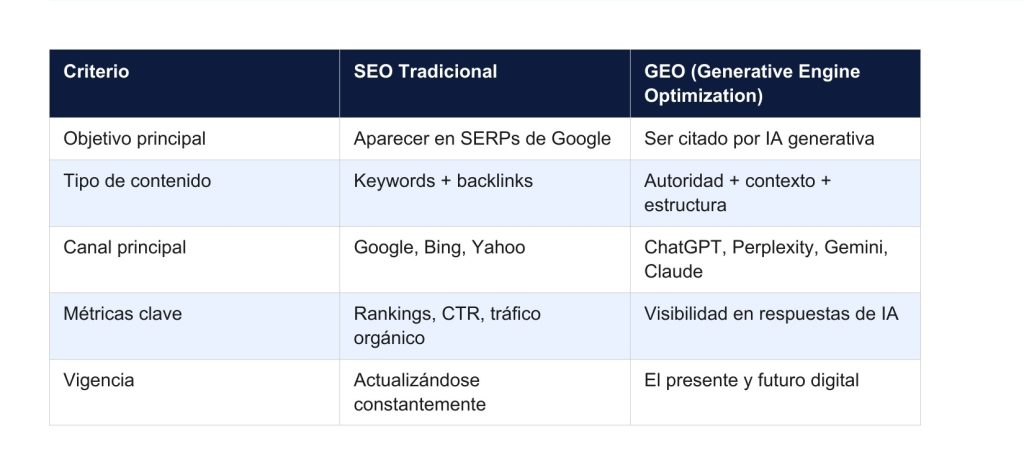
This comparison does not imply that SEO is dead. It means that SEO alone, without a GEO strategy, is no longer enough to guarantee full visibility in today’s digital ecosystem.
Large language models (LLMs) like GPT-4, Gemini, or Claude do not index web pages in real time the same way Google does. However, they learn from massive training data and, in the case of tools like Perplexity or ChatGPT’s search mode, actively crawl the web to generate updated answers.
To appear in the answers of these systems, your content must meet a series of specific criteria that we at Merissel call the GEO Pillars:
AI models prioritize sources that demonstrate deep knowledge in a specific area. It is not enough to have an article on a topic; you must build a content architecture that establishes your brand as a reference in that field.
AI prefers content that answers questions clearly, directly, and in a structured way. Question-and-answer formats (FAQ), lists, precise definitions, and verifiable data are especially effective.
The concept of E-E-A-T (Experience, Expertise, Authoritativeness, Trustworthiness) from Google takes on a new dimension in GEO. AI models value trust and expertise signals: mentions in authoritative media, content signed by recognizable experts, original data, and citations from verifiable sources.
Proper use of structured data (Schema.org) allows AI to better understand the context, type, and relevance of content. It is a critical technical signal for positioning in both SEO and GEO.
Many AI models are trained or feed their responses from specific sources: Wikipedia, specialized publications, relevant media outlets, authoritative forums like Reddit, and platforms like GitHub or LinkedIn. Building presence in these ecosystems is part of an effective GEO strategy.
The question is not whether GEO will impact your business, but when and by how much. Here are five key reasons:
More and more users start their purchasing decision, research, or problem-solving process in a conversational AI instead of a traditional search engine. This radically changes the point where your brand needs to be present.
When AI recommends a brand or service, users tend to perceive it as more credible than a sponsored result on Google. Appearing in these answers is equivalent to getting a recommendation from a neutral expert.
Most companies have not yet implemented GEO strategies. This represents an extraordinary window of opportunity for brands that act now before the market becomes saturated.
A good GEO strategy improves domain authority, content quality, and user experience—factors that also benefit traditional SEO. They are not rival strategies; they are complementary layers of digital visibility.
Google AI Overviews is already active in multiple markets. Bing has Copilot integrated. The line between search engine and generative AI is disappearing. Companies that position themselves in GEO today will be ready for the future of search.
Did you know that Google AI Overviews responses can reduce up to 30% of the CTR of top organic results? Brands cited by AI not only don’t lose traffic—they gain authority and qualified visibility.
At Merissel, we have developed a comprehensive GEO methodology that starts with a visibility diagnosis in AI models and builds a personalized roadmap. But if you want to take the first steps today, we recommend:
At Merissel, we specialize in AI SEO and Generative Engine Optimization. Our team works at the intersection of content marketing, advanced SEO architecture, and large language model optimization.
We help companies and brands become visible not only on Google but also in the new generative search ecosystem: ChatGPT, Perplexity, Gemini, Copilot, and the search engines of the future.
Do you want to know if your brand appears in AI answers when your clients ask questions about your industry? Request your free GEO Visibility Audit with the Merissel team.
GEO is not a passing trend or a digital marketing fad. It reflects a structural change in how people access information, make decisions, and discover brands.
Companies that understand and act on this change now will have a sustainable competitive advantage. Those who wait will have to catch up in a market where generative AI will have already consolidated its own reference sources.
SEO is not dead. But SEO without GEO is no longer enough. At Merissel, we are here to help you navigate this new landscape with strategy, data, and results.



Error: Formulario de contacto no encontrado.